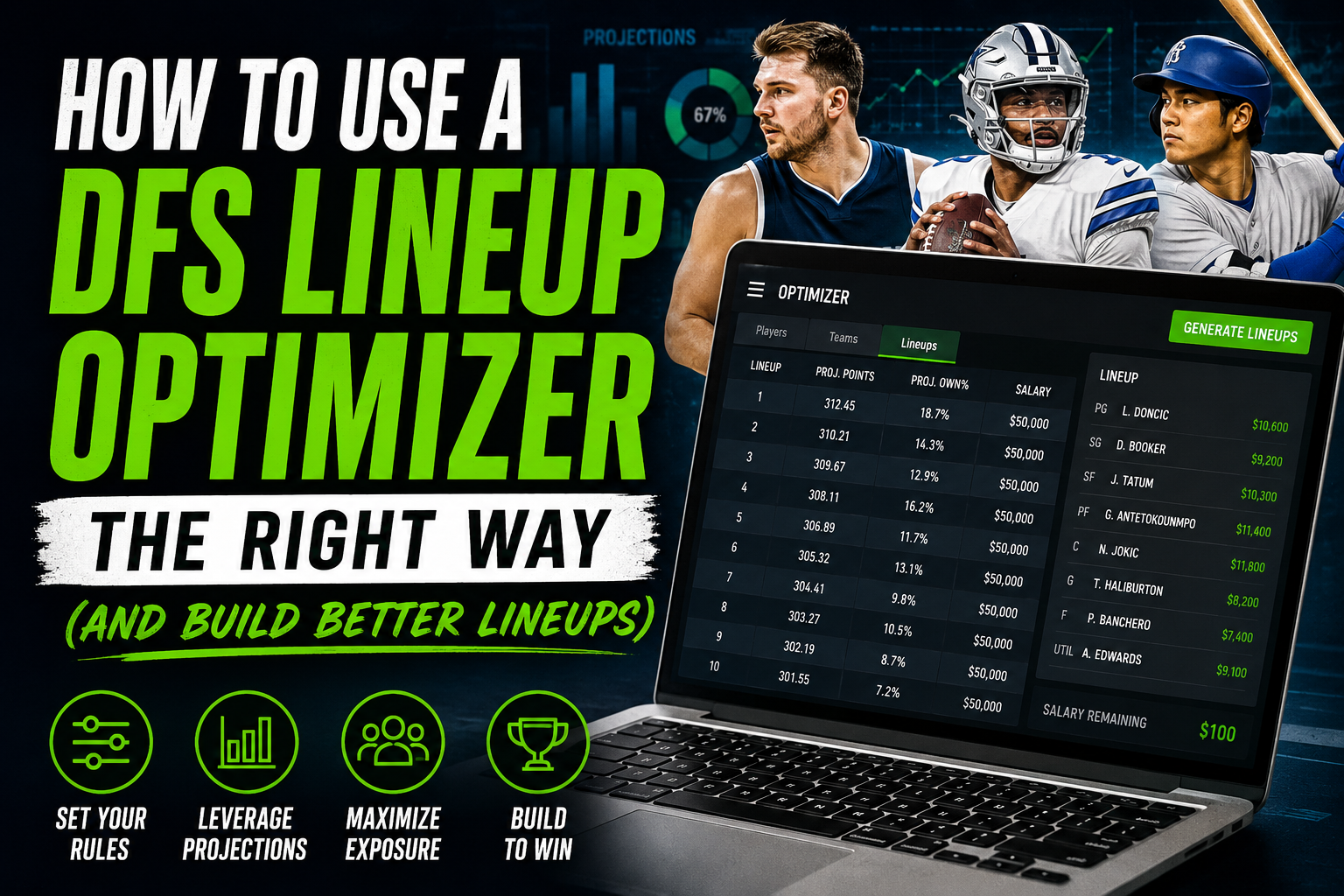
Most DFS players use a lineup optimizer to help them build lineups. Unfortunately, very few use one correctly. That, or they simply have unrealistic expectations.
This is why some people can generate 150 lineups and still lose money, while others consistently find profitable builds from the same player pool. Why? Because a DFS lineup optimizer is not a magic button that guarantees profit or even does everything for you. Rather, it’s a tool. The quality of the lineups it produces depends entirely on the rules, projections, and strategy you give it.
If you’re simply clicking “build lineups” and hoping for the best, you’re leaving a lot of money on the table. Want to improve your game? Here’s how to actually use a DFS lineup optimizer the right way.
Start With Good Projections
Every optimizer is only as good as the projections feeding it. Think of projections as the foundation of the entire process. If your projections are inaccurate, the optimizer will confidently build bad lineups.
Before adjusting any settings in your lineup tool, make sure you’re using projections that account for:
- Playing time
- Matchup
- Usage rates
- Injury news
- Historical performance
- Game environment
Once your projections are loaded, then it’s time to start building. You can have a hand in this process and tweak it, or you can use a tool that actually does do a lot of the heavy lifting for you. That’s precisely what our DFS lineup tool does, as it bakes projections and simulations together, while spitting out up to 1,000 lineups for you to choose from.
See what one of our loyal subscribers has to say about it and try it now for free for 7 days.
Use Exposure Caps to Control Risk
One of the biggest mistakes DFS players make is allowing a single player to appear in 80%, 90%, or even 100% of their lineups.
If that player smashes, you feel like a genius. But if that player gets into foul trouble, gets hurt, or simply has a bad game, you’re looking at a pretty brutal night.
Exposure caps help spread risk across your portfolio. For example:
- Max 40% Player A
- Max 35% Player B
- Max 25% Player C
Instead of relying on one outcome, you’re creating multiple paths to success. The larger your lineup set becomes, the more important exposure management becomes.
For single-entry contests, exposure isn’t really a concern. For 20-max or 150-max contests, it’s one of the most important settings you’ll use.
Setting exposures inherently doesn’t guarantee anything. But completely ignoring this aspect of DFS lineup optimizers can cut into your game, especially when your competition knows how to utilize it.
Add Randomness to Create Unique Lineups
Without randomness, optimizers tend to repeatedly build the same lineup structures. That’s because projections naturally push the optimizer toward the highest projected combinations.
The problem? Thousands of other users are doing the exact same thing. Adding randomness introduces controlled variance. Instead of you spending time going through every single lineup, you can use your lineup tool’s features to manipulate ownership and lineup structure to your benefit.
A common range is:
- 10% randomness for smaller contests
- 15-25% randomness for large-field GPPs
This allows the optimizer to explore alternative lineup combinations that still project well but won’t be duplicated nearly as often. How aggressive you get with it is entirely up to you.
But you don’t want complete chaos. Instead, strive for simply enough variation to uncover lineups that projections alone may overlook.
Build Around DFS Stacks
DFS is often won through correlation. When one player succeeds, another player benefits. That’s why stacking remains one of the most powerful strategies in DFS.
| Sport | Best Correlation Stacks | Why They Work |
|---|---|---|
| NFL DFS | QB + WR, QB + WR + Opposing WR, QB Double Stacks (QB + 2 WR/TE) | Passing production is highly correlated. Bring-backs increase the chances of a competitive, high-scoring game that boosts fantasy output on both sides. |
| MLB DFS | 5-Man Stacks, 4-Man Stacks, Game Stacks | Runs, RBIs, and plate appearances are connected. When one hitter succeeds, teammates often benefit, creating tournament-winning upside. |
| NBA DFS | Game Stacks – Mini Correlations (2-3 players from the same game) | Full-team stacking has limited value, but targeting fast-paced, high-total games can maximize fantasy environments and overtime potential. |
Use Player Groups to Control Lineup Construction
Player groups are one of the most underutilized features in DFS. Groups allow you to tell the optimizer exactly how players should interact.
For example:
- If Player A is used, include Player B.
- If Player C is used, exclude Player D.
- Use at least one player from a specific game.
- Limit certain combinations.
This helps eliminate lineup mistakes while creating more intentional builds. Instead of manually reviewing hundreds of lineups, you can create rules that automatically enforce your strategy.
The more advanced you become as a DFS player, the more valuable player groups become.
Don’t Ignore Ownership Projections
Ownership matters. A lot. Ignoring ownership can be extremely dangerous, as it prevents you from knowing when to capitalize on a low-owned gem, and when to avoid bad chalk.
Two players can project for the exact same fantasy score. If one is expected to be 35% owned and the other is projected at 8%, the lower-owned option often carries significantly more tournament value.
This doesn’t mean fading every popular player, but it does mean you should have an understanding of how ownership affects your chances of climbing a leaderboard.
A quality optimizer should allow you to:
- View projected ownership
- Set ownership caps
- Target leverage plays
- Build around lower-owned combinations
Large-field tournaments are rarely won with the safest lineup. They’re won by combining strong projections with strategic leverage. You can play chalky options in cash games all you want, but for a big takedown, going against the grain and targeting low-owned, high-upside plays is how you can separate from the pack.
Simulations Are Where the Real Edge Comes From
Most DFS players stop at projections, but the sharpest players go one step further: simulations.
Sims aren’t necessarily a free pass to winning in DFS, but they are incredibly useful. After all, a projection gives you a single expected outcome, while a simulation shows thousands of possible outcomes.
That difference matters.
A player projected for 40 fantasy points might:
- Score 25 points 20% of the time
- Score 40 points 40% of the time
- Score 60+ points 15% of the time
Those ceiling outcomes are often what win tournaments. Simulations help identify players and lineups that have true upside, not just strong median projections. This is where many DFS players gain their biggest edge.
Instead of asking, “Who projects best?” They’re asking, “Who helps me win the tournament most often?”
The final answer won’t always be right, but sims are going to uncover plays (or downgrade others) and shed light on a slate to have you see it in a whole new way.
The Best DFS Lineups Come From Combining Everything
There’s no single setting that suddenly makes an optimizer profitable. You still need to put in the time and effort to research a slate, know the DFS sport, understand matchup angles, and offer real-life context.
In general, the strongest DFS builds usually combine the following:
- Accurate projections
- Smart exposure caps
- Controlled randomness
- Correlated stacks
- Strategic player groups
- Ownership awareness
- Simulation data
Each layer improves lineup quality. Collectively, they create a process that gives you a legitimate edge.
You can still get by with hand-building or ignoring some of these key categories, but bunching them all together and letting a strong DFS lineup optimizer crunch the numbers will cut your research in half and produce lineups you may never reach on your own.
Why You Should Use Our DFS Lineup Tool
Most optimizers focus on creating lineups that are based around projections. They spit out lineups that can win, but they aren’t always going to factor in everything. They’re also more expensive, difficult to use effectively, and/or used by a lot of your competition.
We wanted to focus on creating better lineups, so we created a tool that combines advanced simulations, ownership projections, exposure controls, stacking rules, player groups, and lineup rankings into a single platform designed for serious DFS players. Everything you need, all in one spot.
The lineups are ready to rock. All they need is your individual research and context to make the final call.
Whether you’re building one lineup or 1,000, the goal is the same: Give yourself the best possible chance to finish at the top of the leaderboard.
Want to gain an edge? Try our DFS lineup tool, free for 7 days.

Playing DFS since the days of DraftStreet, Kevin knows the ins and outs of DFS, specifically for NFL and NBA. He’s also been helping people win in fantasy football leagues for 15+ years and is one of many experts featured at FantasyPros.
Want more winning DFS plays like this? Get our daily core plays, leverage spots, and strategy sent straight to your inbox.









Leave a Reply