
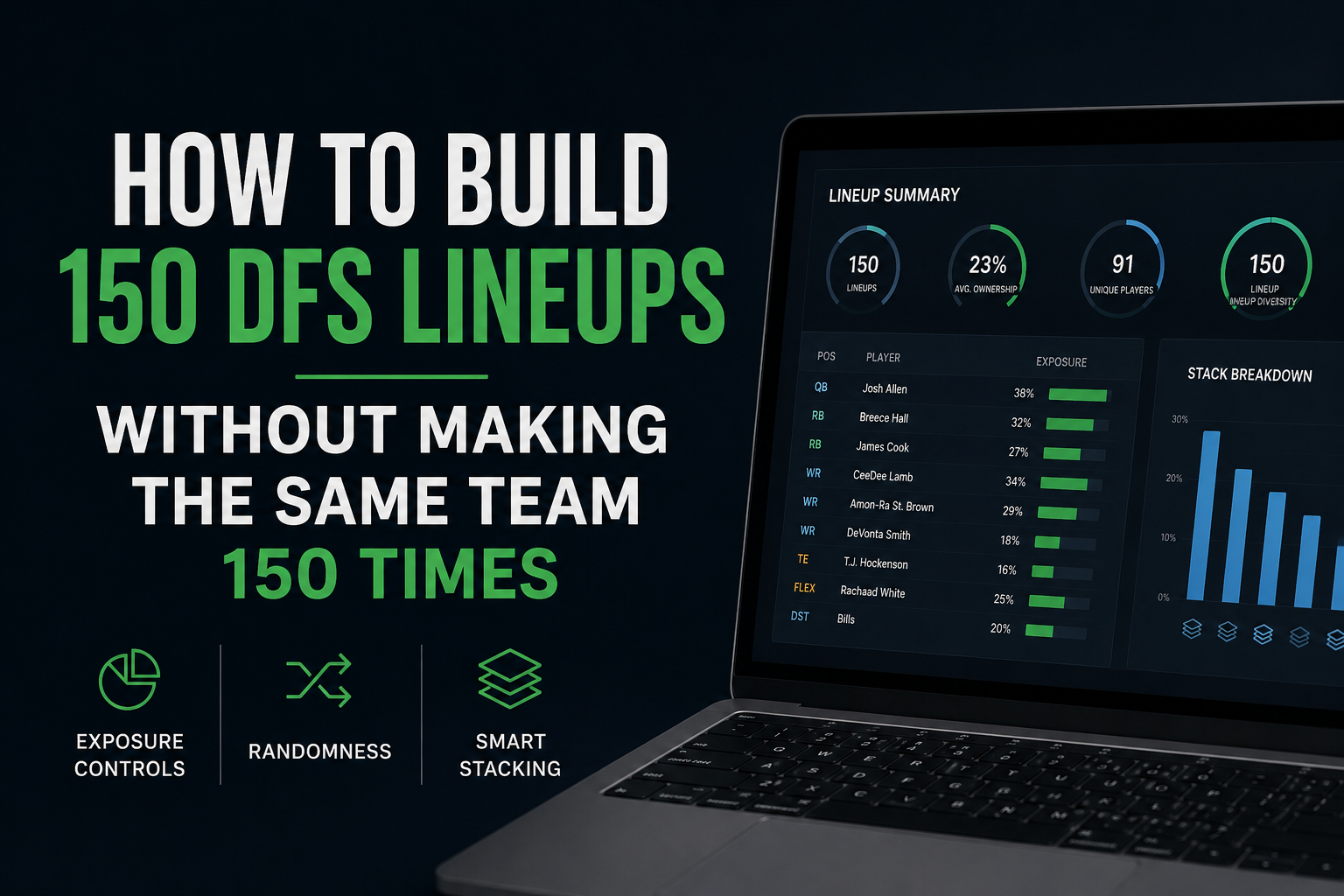
If I could enter 150 DFS lineups I’d win $1,000,000. We hear that all the time. I get it, it’s tough to see the big sharks get massive takedowns. Watching anyone win $10,000 or $100,000 while you’re grinding away for small gains is never easy.
However, maxing 150 lineups in DFS doesn’t actually guarantee you anything. In fact, there are a few key reasons why simply tossing 150 lineups into a huge GPP doesn’t mean you’re going to win anything of substance.
You Start Contradicting Yourself (in Your Lineups)
One of the biggest problems with rolling out a ton of DFS lineups is that you start having too many different combinations. Obviously if you max 20 or 150 lineups, you want that, but at a certain point you are going to contradict what you actually believe.
Put simply, if you analyze a slate and research it, you are going to come away with some takes. One set of takes will either align with or go against the main chalk of the slate. The second set will prop up secondary or even tertiary plays that end up being more contrarian.

But the more lineups you have, the further away you get from that first set of plays, and unless you lock in those plays everywhere, you can’t really control which plays mesh with which.
Controlling exposures and making sure specific players are in your player pool only gets you so far. The more DFS lineups you have, the harder they are to manage on a granular level.
Example: You are extremely high on Joel Embiid in NBA DFS. Your research suggests he should be in every lineup you build, but rolling out 20 lineups demands you diversify.
You can then get into a situation where you have Embiid in 70% of lineups, but the 30% you don’t have Embiid are the lineups with the combination of players needed to get a takedown.
Bankroll Volatility Spikes Without Improving ROI

More DFS lineups don’t always smooth out variance. They often magnify it. Despite an attempt to do just the opposite, each additional entry you create adds rake and increases short-term swings without meaningfully improving long-term returns.
If your average DFS lineup isn’t clearly +EV, scaling volume simply accelerates losses and creates wild bankroll swings that feel like bad luck but are really structural.
In other words, if your process is flawed internally for a given slate, there is risk of it branching out and touching all of the extra lineups you curate.
The fix would be to scale back the number of lineups you’re building, or to isolate each created lineup and make sure they’re as rock solid as possible. Of course, the higher your lineup count grows, the harder this is to actually execute.
You Have a Ton of Lineups Lacking Proper Versatility
The whole point of creating a ton of lineups in DFS is to make sure all of your eggs aren’t in one basket. More importantly, though, you’re seemingly ensuring that you’re taking your eggs – and eggs you’d normally never even consider using – and tossing them in many different baskets.
A lot of builds can rely on one narrow outcome because they are rushed or built as “fillers”. When that single assumption fails,. the entire lineup collapses. If you create fewer lineups, you can build entries that still compete if a game underperforms or a chalk play disappoints. This gets you true versatility, rather than all-or-nothing constructions.
This one is a two-way street.
Example: You want added versatility so you create a lot of lineups, set player exposures, and also set a rule for at least two unique players per lineup.
On one hand, you are definitely creating several lineups and none of them are 100% the same. In fact, two of the plays in every lineup is unique compared to the last.
On the other hand, however, that may not be different enough, where you set your exposures can still dictate the health of a given individual lineup, and the two unique players used may not actually be optimal choices.
Hand building at scale is akin to drawing on the wall like a caveman. But throwing caution to the wind and trusting that a lineup optimizer will figure it out isn’t always automatically better. Making sure there’s some type of in between is key if you’re maxing a DFS contest.
Ie, you absolutely can and should use a lineup tool. And you absolutely can and should touch your lineups yourself with intent, both with build rules and personal tweaks.
You Stretch Yourself Way Too Thin
Another big issue goes back to player exposures. Depending on the slate and which plays truly stand out, how much you commit to a top core of players can decide how successful you are.
Obviously if you go 100% on 3-4 players and they all smash, you’re sitting pretty. Then you just need the unique plays to hit and whatever other options you’re highly exposed to, most of them need to do decently. Then you have a chance.
But what if you scale things way back and try to get more exposure to as many plays as possible? It’s hard not to fall in love with every appealing play on a given DFS slate, after all. However, without taking some type of stand, you eventually stretch yourself too thin.
If you find yourself getting to “everyone”, then all those extra lineups and the unique plays that you rely on the optimizer to generate start to fall off. At the heart of any lineup – or stack of lineups – needs to be some semblance of a core. There needs to be something that emulates a foundation, even if it’s stretched out across a litany of lineups.
Why Less Volume Means More Winning in DFS
Winning in DFS – regardless of the sport genre – isn’t about maximizing entries. It’s about maximizing decision quality. Playing fewer lineups forces you to actually take clearer stances, concentrate on your best strategy for a given slate, and avoid buying into low conviction builds.
Rather than just hope one of many lineups gets lucky, you can position yourself to profit when your reads are right. True, when you miss the mark on your core you’re going to struggle to cash, and a takedown won’t be in the cards. But the losses won’t be nearly as devastating, and when you do hit on your core, winning is made that much easier.
Over time, the discipline you use in your build process should lead to lower volatility, cleaner ROI, and more consistent results. None of this means you can’t max enter big contests. But your probability of succeeding consistently is low, and getting to the top spot versus thousands of lineups isn’t very likely.
For more consistent results, keep your volume low and your focus on building the best lineup possible.

Playing DFS since the days of DraftStreet, Kevin knows the ins and outs of DFS, specifically for NFL and NBA. He’s also been helping people win in fantasy football leagues for 15+ years and is one of many experts featured at FantasyPros.
Want more winning DFS plays like this? Get our daily core plays, leverage spots, and strategy sent straight to your inbox.












Leave a Reply