
Some players will just hit “Build Lineups” and roll with whatever the optimizer spits out. Others will throw together a roster of guys they know and hope their gut call hits. That’s fine if you’re playing for fun, but if you want to win tournaments, you need a process.
Most of the real money in DFS comes from GPPs. These contests reward upside and unique builds. Your goal isn’t to simply cash, it’s to beat thousands of other entries.
Want to learn how? Continue on with my DFS guide to GPP strategy.
The Price of Ownership
Ownership has a reputation problem. People see a chalk player and act like he’s untouchable. That’s not the case.
Ownership is a cost you pay every time you add a player. Think of it like a second salary cap that sits next to your budget. Salary shows how much of your $50,000 you’ve spent, while ownership shows how much of your lineup looks like everyone else’s.
If you fill your roster with chalk, you’re paying the highest ownership price. Those plays may project well, but you’ll need them all to hit just to keep pace. On the other hand, if you build a lineup full of 0.1% players, you’ve avoided ownership but also sacrificed projection. That kind of lineup isn’t smart contrarian play, it’s just weak.
The goal is balance. Some ownership is fine because chalk players often project the best. The mistake is treating ownership as always bad. You don’t need to avoid it completely. You need to spend it wisely. A lineup with a couple of high-owned anchors mixed with some sharp pivots is much stronger than a build that leans all one way.
Contest size changes how much ownership you can carry. In a 1,000-entry single-entry, duplication isn’t as big of a threat, so you can play more chalk. In massive GPPs, every percentage point matters. That’s when you need better pivots and unique roster construction to separate yourself.
Ownership is a currency. If you spend it recklessly, your lineups will look like everyone else’s. If you spend none of it, your lineups will lack projection. Spend it smartly, and you’ll find the right mix of leverage and upside to compete for the top spots.
Relative Value in Large Fields
In big contests, ownership works differently. A 40% player in a 1,000-entry field isn’t the same as a 40% player in a 50,000-entry GPP. In small contests, you can eat that ownership if the play helps anchor your lineup. In the big ones, the opportunity cost is massive.
That’s where relative value comes in. If two players project about the same, but one is 40% owned and the other is 8%, the 8% guy brings more relative value. You’re getting similar projected points, but fewer of your opponents have access to them if you opt for the 8%-owned player.
This doesn’t mean you fade every popular play. It means you balance the ownership you spend with contrarian pieces that give your lineup a path to stand out.
The Benefits of Being Contrarian
Projection alone doesn’t win GPPs. Everyone has access to the same numbers. What matters is how your lineup stacks up against the field.
- Leverage: If a chalk piece fails, fading him can instantly put you ahead of a big chunk of lineups.
- Ceiling: Volatile players scare the field, but volatility creates the blowup games you need to finish first.
- Duplication: Unique builds protect your prize pool equity. Splitting first 500 ways kills your EV.
- Recency Bias: The field chases last week’s results. Contrarian players take advantage when nothing has changed under the hood.
Projection Misconceptions
Projections get treated like gospel when they’re just educated guesses. A projection is a midpoint, not a promise. If a model has a player at 20 points, that’s his median outcome. Think of it as the 50th percentile on a bell curve. Half the time he’ll score less, half the time more.
On that curve, the left side is the bust range. That’s when a WR gets three targets or an NBA player gets into foul trouble. The right side is the ceiling. That’s when a bench shooter hits eight threes or a backup RB gets unexpected goal-line work. The median is just the middle. It tells you nothing about how wide the distribution is.
That’s the key. Two players can share the same median projection but look completely different when you zoom out. One guy might live around 20 points every game. The other swings from 5 to 40. If you’re building cash lineups, the steady player is fine. In GPPs, the volatile guy is often better because his ceiling tail gives you a chance to lap the field.
The mistake is thinking you can win tournaments by stacking a lineup full of medians. If everyone hits their midpoint, you might sneak into a min-cash, but you won’t sniff the top of a big contest. The goal is to find players whose bell curve has a real right-side spike — and then build lineups that give you access to those spikes when they hit.
Pitfalls of Going Too Contrarian
Being contrarian doesn’t mean going off the rails. Too much of it can bury your lineup.
- Sacrificing Projection: Low ownership is worthless without a ceiling.
- Galaxy Brain Moves: Don’t force bad stacks or punts just to be different.
- Fading Good Chalk: Sometimes chalk is right. If a cheap NBA starter is locked into 35 minutes, don’t overthink it.
- Overdoing It in Small Fields: You don’t need to fade every 30% player in a 500-entry GPP.
- Tilt: Contrarian builds lose more often. If you can’t handle variance, it’ll wreck your mindset.
Portfolio Building in Multi-Entry Contests
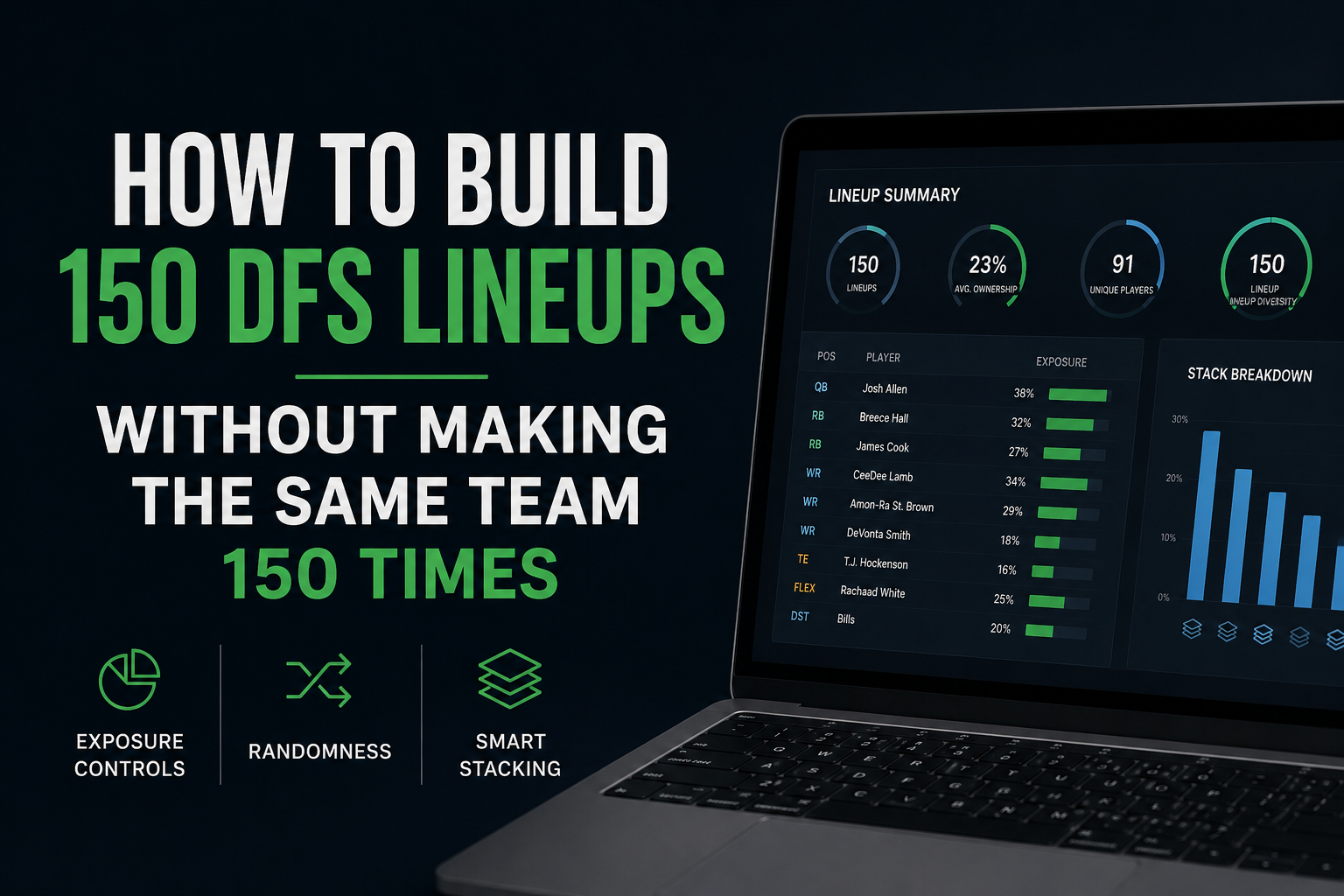
When you’re firing 20, 50, or even 150 lineups, you can’t treat them all the same. Multi-entry play is about building a portfolio instead of obsessing over one “perfect” lineup. The goal is to spread out risk while still giving yourself lineups that can realistically win.
One way to think about it is risk tiers. Some lineups can be chalkier, leaning on the best projections and safer plays. Those builds won’t win the Milly Maker, but they give you better chances of min-cashing and keeping your bankroll alive. Other lineups can swing harder on contrarian pivots. These are the ones that can realistically take down a big field when chalk fails.
Going ultra-contrarian across your entire set is dangerous. If you miss, you walk away with nothing. At the same time, going all-in on chalk limits your upside. You’ll cash more often but rarely win outright because you’re building the same way as everyone else. A balanced portfolio blends both styles so you have outs in either scenario.
Here’s the mindset: you don’t need every lineup to win. You just need one of them to connect. If you’re entering 20 lineups, maybe 10 lean chalkier, 6 are balanced mixes, and 4 swing for the fences. That way, you reduce the chance of a complete wipeout while still giving yourself multiple paths to first place if the slate breaks in your favor.
Contest size should guide your portfolio too. In small-field GPPs, you don’t have to get crazy. In massive fields, you’ll need sharper contrarian plays mixed into your builds to separate yourself from the pack. Knowing the difference — and spreading your exposure across lineups — is how you survive the grind of multi-entry tournaments.
Lineups, Not Players
DFS is a lineup game, not a player-picking contest. People get hung up on whether a certain guy is “good chalk” or “bad chalk,” but that mindset misses the point. A player can look terrible in isolation and still work inside the right lineup.
Take a running back who’s projected at 60% ownership. By himself, that number feels scary. If you just jam him into a lineup full of other chalk, then yeah — you’ve got a build that looks like half the room. But if you pair him with an overlooked game stack or surround him with lower-owned ceiling plays, he can still be part of a +EV construction.
Think about it like puzzle pieces. A single piece doesn’t matter until you see the full picture. The same goes for DFS lineups. A chalk RB or WR can help boost projection and stability, but you balance that with contrarian spots elsewhere so the full lineup still has leverage.
This is why fading every chalk piece just to be contrarian is a mistake. High-owned players are popular for a reason. They project well, they’re in good spots, and sometimes they’re locks for volume. What matters is whether your lineup as a whole creates a unique path to first place.
You should always ask: how does this player fit into the lineup I’m building? Does he balance out the risk of a contrarian stack? Does he anchor projection so I can take shots elsewhere? If the answer is yes, then even “bad chalk” can become profitable inside the right build. You should have intention with every player you slot into a lineup.
That’s the mindset shift. Stop treating ownership like a scarlet letter tied to one player. Start treating it as a cost across your lineup. The best tournament players don’t play players — they play lineups.
Contrarian Play and Slate Outcomes
Contrarian lineups are more likely to win when slates score low. When chalk players smash across the board, the top lineups usually look the same.
The edge comes on nights when things break down. A 60% stud busts, a popular game flops, or ownership clusters around the wrong spots. That’s when leverage-heavy lineups climb the leaderboard.
You won’t hit every night. Chalk wins plenty of slates. But when it doesn’t, contrarian builds give you the best chance to actually win first place instead of just sneaking into the cash line.
How to Deploy a Winning DFS GPP Strategy
Being contrarian is about balancing projection, ownership, and upside at the lineup level.
You won’t win often, but when you do, you’ll be positioned to actually win big. That’s the difference between min-cashing and taking down the top prize.

Taylor Smith been a profitable DFS player for years, turning his passion for fantasy sports into both consistent results and quality content. Since 2018, he’s created fantasy analysis and strategy pieces for several outlets, most notably RotoGrinders and FantasyLabs, where he’s covered everything from daily picks to advanced DFS theories.
Want more winning DFS plays like this? Get our daily core plays, leverage spots, and strategy sent straight to your inbox.







Leave a Reply