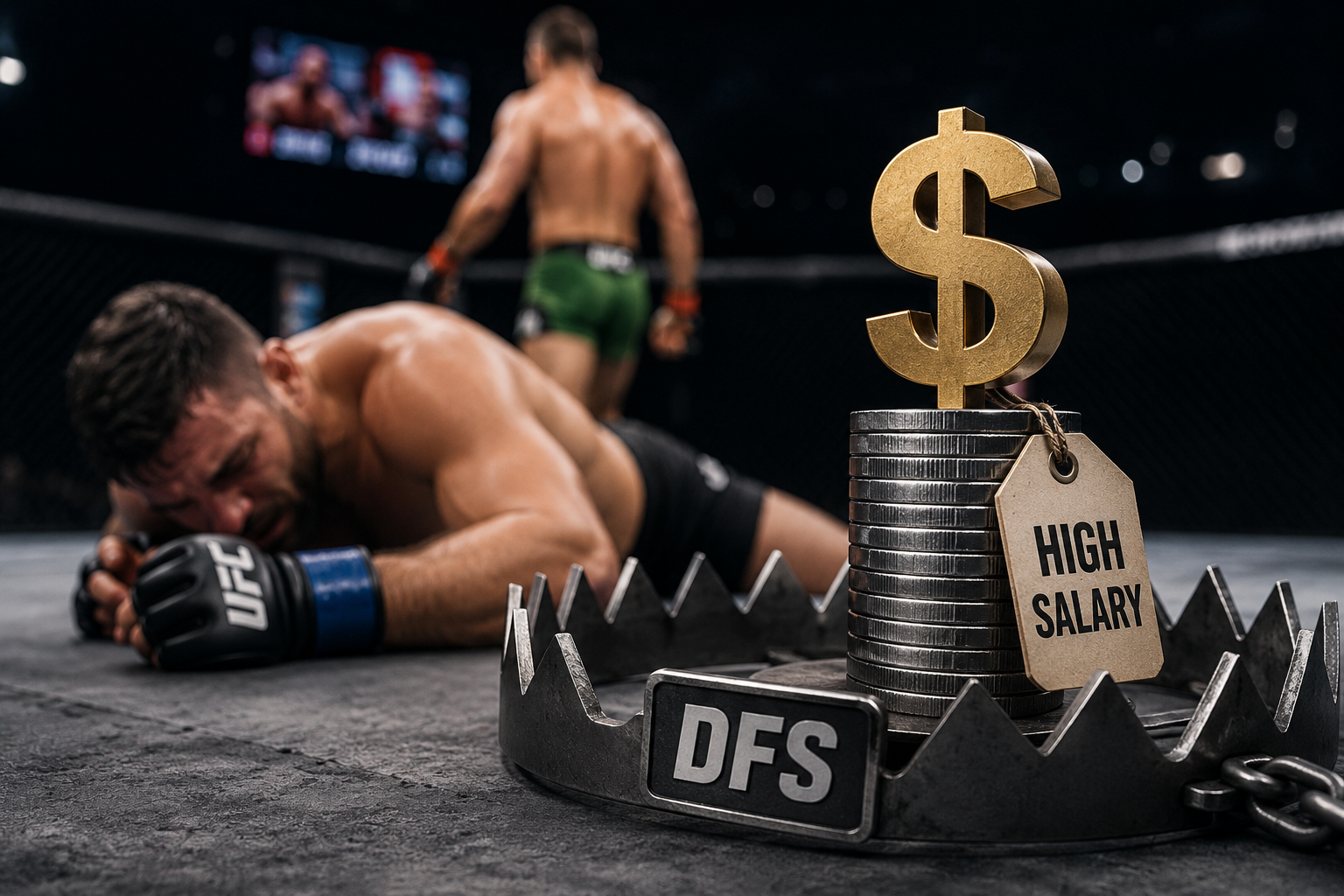
One of the biggest mistakes new MMA DFS players make is assuming expensive fighters are “safe.”
They see a fighter priced at $9,400 with -400 odds and immediately lock them into cash games, tournaments, or both. It does feel logical, after all. Vegas expects them to win. The fighter is popular. The salary must be justified.
But in MMA DFS, expensive fighters fail far more often than people realize. And even when they do win, they don’t always win in a way that helps you. That’s where a lot of lineups quietly die.
Winning Isn’t Enough in MMA DFS
This is the first lesson newer players need to understand: A fighter can win and still hurt your lineup.
DFS scoring rewards finishes, knockdowns, control time, advances, and high-volume striking. A slow decision win from a $9,500 fighter usually isn’t enough to help you win a large-field tournament.
Meanwhile, a cheaper underdog who scores a knockdown and wins a wild decision can easily outscore them at a fraction of the salary and ownership.
That’s the trap.
Many expensive fighters are priced for perfection. If they don’t get an early finish or dominate statistically, they often fail to justify the salary.
Expensive Fighters Carry Massive Ownership
The other issue is ownership. Newer players naturally gravitate toward:
- Heavy betting favorites
- Undefeated prospects
- Big-name fighters
- Fighters expected to finish
That creates inflated ownership on expensive fighters every single slate.
If a $9,300 fighter comes in at 50% ownership and scores 82 points in a decision win, that’s not helping you much in tournaments. Half the field has them.
But if that same fighter loses or scores poorly? Now half the field is dead instantly. That’s where leverage enters the conversation.
MMA Is More Volatile Than Most DFS Sports
NFL and NBA favorites generally win at predictable rates. MMA doesn’t work like that. One punch changes everything.
A fighter can dominate 14 minutes of a fight and still get knocked out seconds later. A heavy favorite can gas out, get caught in a submission, or lose a close decision because of poor pacing.
Variance is a massive part of UFC DFS. That’s why blindly jamming expensive fighters into lineups is usually a losing long-term strategy.
You want exposure to strong favorites, sure. But you also need to think about:
- Ceiling
- Ownership
- Fight style
- Pace
- Finish upside
- Cardio risk
- Wrestling dependency
- Five-round potential
Salary alone tells you almost nothing. Simply clicking the most expensive fighters without proper context or doing your research is a dangerous idea, in more ways than one.
Some Expensive Fighters Are “Fake DFS Plays”
This is one of the sharpest concepts in MMA DFS. Some fighters are great real-life fighters but mediocre DFS plays.
For example:
- Low-volume strikers
- Point fighters
- Fighters who coast with leads
- Decision-heavy grapplers
- Counter strikers who fight slowly
These fighters may win consistently while still failing to break optimal lineups. Meanwhile, aggressive fighters with high pace and finishing instincts often smash DFS value even in losses.
That’s why experienced players focus heavily on style matchups instead of simply targeting betting favorites.
Expensive Fighters Also Break Lineup Flexibility
Paying up for two or three expensive fighters forces the rest of your lineup into uncomfortable territory.
You suddenly need low-priced punts, risky underdogs, or fighters with limited paths to scoring. That creates fragile lineup construction.
Sometimes the better build is balanced lineups filled with fighters in the $8K range who have real finishing upside but lower ownership. Those lineups tend to survive chaos better, especially on volatile cards.
The Best MMA DFS Players Build Around Outcomes
Sharp MMA DFS players don’t ask: “Who’s most likely to win?” They ask: “Who’s most likely to break the slate?”
That’s a massive difference.
A fighter scoring 115 points at 18% ownership matters more than a fighter scoring 85 points at 48% ownership.
The goal isn’t to simply pick winners. The goal is to build lineups capable of finishing first. That requires combining leverage, ownership, and scoring potential together.
How to Avoid the Expensive Fighter Trap
Expensive fighters in MMA DFS are admittedly pricey for a reason. Some are great and worth spending the cash for, while others are simply traps.
Here are a few quick ways to decide when and when not to pay up:
Prioritize pace and finishing upside
Fast fights create DFS scoring. Slow kickboxing matches usually don’t.
Don’t blindly stack favorites
Multiple expensive favorites winning by decision is one of the most common ways lineups fail.
Embrace uncomfortable underdogs
Underdogs with knockout power or grappling upside can completely flip tournaments.
Fade over-owned fighters occasionally
You do not need every popular favorite. Strategic fades create leverage.
Think about lineup construction as a whole
A lineup filled with six “good plays” is not always a tournament-winning lineup.
Correlation, ownership, and ceiling matter together.
Think Before Paying for Expensive MMA DFS Fighters
Expensive MMA DFS fighters are not automatic plays. In many cases, they’re overpriced, over-owned, and overly dependent on perfect outcomes.
That doesn’t mean avoiding favorites entirely. It means understanding that salary and betting odds alone do not equal DFS value.
The sharpest UFC DFS players attack volatility instead of fearing it. That’s where the real edge begins.
And honestly, this is where lineup builders become incredibly valuable. Seeing ownership, projections, salary combinations, and lineup ceilings together makes it much easier to avoid overpriced traps and build lineups with actual tournament-winning upside.

Playing DFS since the days of DraftStreet, Kevin knows the ins and outs of DFS, specifically for NFL and NBA. He’s also been helping people win in fantasy football leagues for 15+ years and is one of many experts featured at FantasyPros.
Want more winning DFS plays like this? Get our daily core plays, leverage spots, and strategy sent straight to your inbox.





Leave a Reply