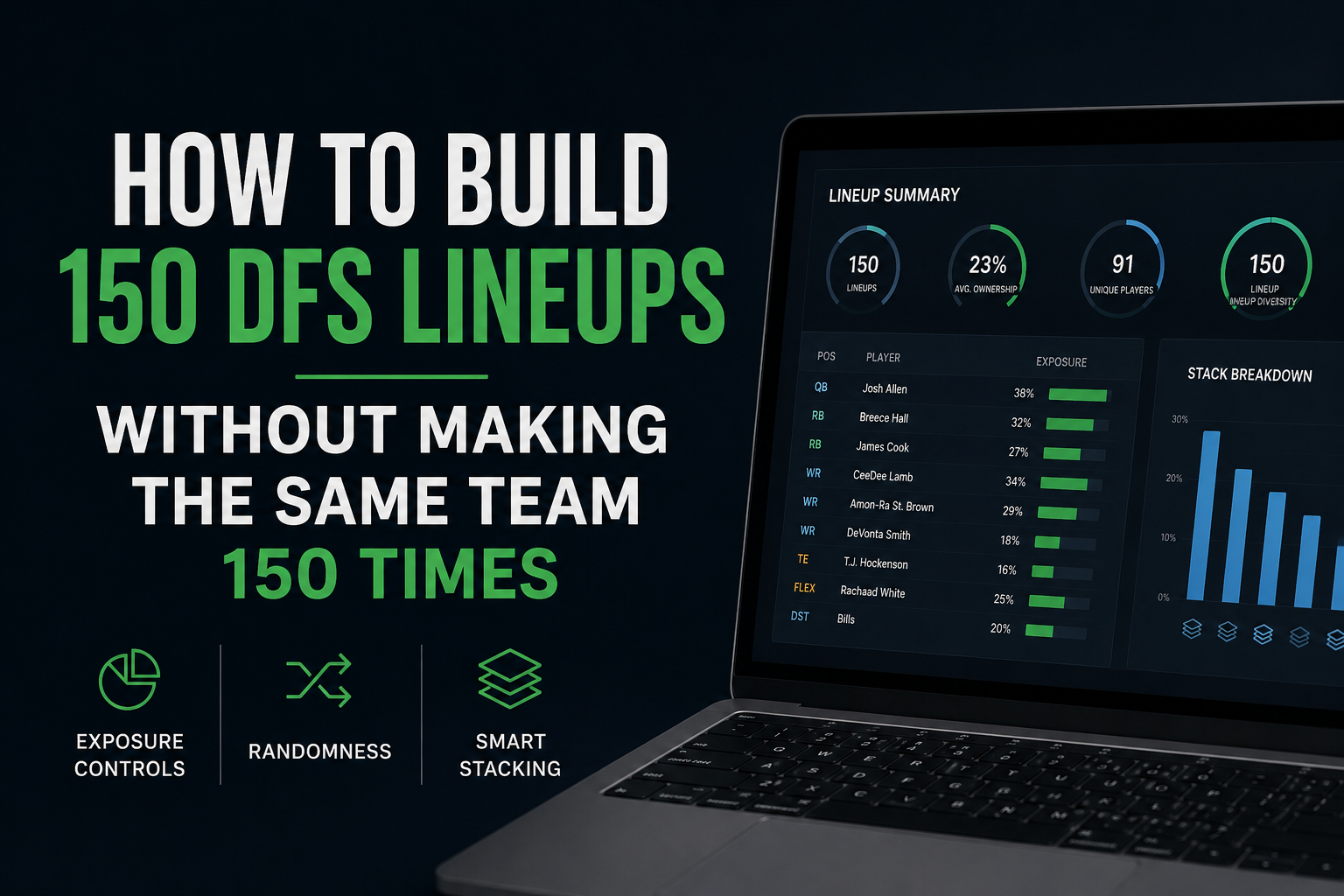
Building 150 DFS lineups sounds like diversification. In reality, a lot of players are just entering the same lineup 150 different ways. Maybe one team swaps a cheap WR. Another changes a defense. But the overall build stays almost identical.
That’s a problem.
Large-field tournaments are won with lineup uniqueness, leverage, and smart portfolio construction. If all 150 of your entries tell a similar story, your chances of actually winning a GPP drop fast.
The good news is this is fixable.
Once you understand exposure caps, randomness, stacking rules, and player groups, building 150 lineups becomes a lot more intentional. Instead of mass entering lineups, you’re building multiple paths to first place.
Why Most 150-Max Players Aren’t Actually Diversified
A common misconception in DFS is that more lineups automatically means more diversification.
That isn’t always true.
Most optimizers naturally prioritize the highest projected plays. If you simply lock projections and generate 150 teams, the optimizer will continuously build around the same core players and lineup structures. You might technically get 150 unique lineups, but strategically, many of them are nearly identical.
The “Same Core” Problem
This is one of the biggest mistakes players make in large-field GPPs. You definitely want to get exposure to the players you like the most, but should you always pair the same players together every time?
For example, imagine 120 of your 150 lineups contain:
- the same quarterback
- the same RB value play
- the same chalk wide receiver
At that point, your entire portfolio is dependent on one very specific game environment succeeding.
If those plays fail, your entire night is essentially dead.
Professional DFS players think in terms of portfolio outcomes, not just individual lineups. They want multiple paths to first place, not 150 slightly different versions of the same outcome.
Duplication Quietly Kills Profitability
Even if your lineup is strong, duplicated constructions limit your upside.
If 400 people have the same core lineup in a large-field tournament, your ceiling gets capped immediately. Splitting first place multiple ways destroys expected value over time.
That’s why experienced tournament players intentionally create:
- leverage
- alternate lineup constructions
- varying game stacks
- diversified ownership combinations
The goal is not simply to cash. The goal is to build lineups capable of separating from the field.
Start With Exposure Caps Before Anything Else
If you want better 150-max builds, exposure caps are the first thing you should learn to use properly.
Exposure caps control how often a player appears across your entire portfolio. This prevents one player from dominating your builds and helps create more balanced tournament exposure.
Why Exposure Caps Matter
Without caps, optimizers can become overly aggressive on high-value plays.
You may think you are diversified, but suddenly one cheap chalk running back appears in 88% of your lineups because the projections love him.
That creates massive risk.
Even strong plays fail all the time in DFS. Injuries happen. Blowouts happen. Foul trouble happens. Weather changes games. Variance is part of the sport.
Exposure caps protect your portfolio from collapsing around one outcome.
Good Starting Exposure Ranges
There’s no universal rule, but these are solid tournament starting points:
| Player Type | Suggested Max Exposure |
|---|---|
| Elite studs | 35-50% |
| Chalk value plays | 25-40% |
| Volatile tournament plays | 15-30% |
| Contrarian leverage plays | 10-25% |
If you’re regularly playing one player in 70-90% of your tournament lineups, you are usually taking on more risk than you realize.
The larger the field gets, the more valuable diversification becomes.
Randomness Is One of the Most Important DFS Settings
A lot of DFS players misunderstand randomness. They think it “ruins” projections. In reality, it helps create tournament-winning lineup diversity.
Why Projection-Perfect Builds Become Duplicated
If every optimizer user is running the same projections with no randomness, everyone ends up landing on similar lineups.
That’s why you constantly see duplicated builds in large-field contests.
Randomness introduces controlled variation into projections so the optimizer explores different lineup combinations instead of forcing the exact same optimal builds repeatedly.
What Randomness Actually Does
Let’s say a player projects for 42 fantasy points. With randomness enabled, the optimizer may treat him as:
- 39 in one build
- 44 in another
- 41 somewhere else
That slight variation dramatically changes lineup combinations and creates much healthier portfolio diversity.
Recommended Randomness Settings
| Sport | Suggested Randomness |
|---|---|
| NFL | 10-20% |
| NBA | 15-35% |
| MLB | 25-40% |
- MLB generally benefits from higher randomness because baseball outcomes are naturally volatile.
- NBA usually requires a balance between projection accuracy and lineup uniqueness.
- NFL falls somewhere in the middle depending on slate size.
Stacking Rules Help Create Unique Tournament Builds
Stacking is not just about correlation anymore. It also helps create more intentional lineup structures.
Without stacking rules, optimizers can generate random combinations that technically project well but fail to tell a coherent tournament story.
Correlation Matters
DFS tournaments are won through ceiling outcomes. You want lineups where multiple players benefit from the same game environment.
Examples:
- NFL QB + WR + bring-back stack
- MLB 5-man stacks
- NBA game environments with condensed usage
When one piece succeeds, the rest of the lineup benefits alongside it.
Different Stack Types Create Different Paths
One of the best ways to diversify 150 lineups is by varying your stack structures.
For example:
- some NFL builds may feature double stacks
- others may use skinny stacks
- some may prioritize game environments
- others may target leverage offenses
This prevents your entire portfolio from relying on one specific construction type.
Player Groups Are an Underrated DFS Weapon
Player groups are one of the most powerful optimizer features, yet most casual DFS players barely use them. Groups allow you to create intentional lineup logic instead of blindly generating teams.
Prevent Bad Correlations
You can stop lineups from pairing negatively correlated players.
Examples:
- RB against opposing defense
- multiple low-usage NBA role players together
- conflicting MLB hitters
This cleans up lineup quality immediately.
Force Leverage Combinations
Groups also allow you to intentionally create tournament leverage.
For example:
- if chalk RB A fails, force leverage RB B into certain builds
- pair low-owned receivers with high-owned quarterbacks
- create alternate game environments the field is underweight on
This is where lineup building starts becoming strategy instead of pure projection sorting.
Portfolio Construction Is What Separates Good Players From Great Players
This is the biggest mindset shift for serious tournament DFS players. Your 150 lineups should not function as 150 independent teams. They should function as one coordinated portfolio.
Build Around Multiple Outcomes
Instead of forcing one opinion across every lineup, think about multiple possible slate outcomes.
Examples:
- What if the chalk game busts?
- What if weather changes the MLB slate?
- What if the expensive stack underperforms?
- What if the backup RB breaks the slate?
Strong DFS players allocate exposure across several believable tournament paths.
Think About Your Entire Portfolio
Ask yourself:
- Do my lineups have enough leverage?
- Am I overexposed to one game?
- Do I have enough low-owned ceiling combinations?
- Are my builds too similar?
This type of thinking is what helps tournament players become consistently profitable long term.
When a Lineup Builder Actually Becomes Necessary
At a certain point, manually building 150 tournament lineups simply becomes unrealistic. It’s not easy to track the following without automation:
- exposures
- leverage
- randomness
- stacks
- player groups
- ownership
- correlations
That’s where a lineup builder becomes almost mandatory, especially when you’re managing exposures across dozens of entries.
The real advantage of a strong optimizer is not just speed. It’s portfolio control. A good lineup builder allows you to:
- set intentional exposure caps
- build unique tournament constructions
- create custom stacking rules
- manage leverage
- generate diversified player pools
- sort lineups by projection, ceiling, or expected profitability
Our lineup builder was specifically designed to help DFS players build smarter tournament portfolios instead of simply mass-producing random lineups.
The following features make it significantly easier to create diversified GPP builds without losing strategic control of your portfolio:
- custom stacks
- exposure controls
- player groups
- randomness settings
- lineup sorting
- multi-lineup generation
If you’re serious about playing large-field DFS tournaments, learning how to manage your lineup portfolio properly can completely change your long-term results.
Mastering 150 Lineup Builds in DFS
Building 150 DFS lineups is not about clicking “generate” and hoping variance works in your favor. The best tournament players approach DFS like portfolio management.
They intentionally manage:
- exposures
- leverage
- correlation
- lineup uniqueness
- game environments
- ownership dynamics
That’s what creates true diversification.
Once you stop thinking in terms of “best plays” and start thinking in terms of portfolio construction, your DFS process changes completely. And in large-field tournaments, that edge matters far more than most players realize.
Want the maximum edge? Try our lineup tool, complete with projections and sims, FREE for 7 days.

Playing DFS since the days of DraftStreet, Kevin knows the ins and outs of DFS, specifically for NFL and NBA. He’s also been helping people win in fantasy football leagues for 15+ years and is one of many experts featured at FantasyPros.
Want more winning DFS plays like this? Get our daily core plays, leverage spots, and strategy sent straight to your inbox.



Leave a Reply