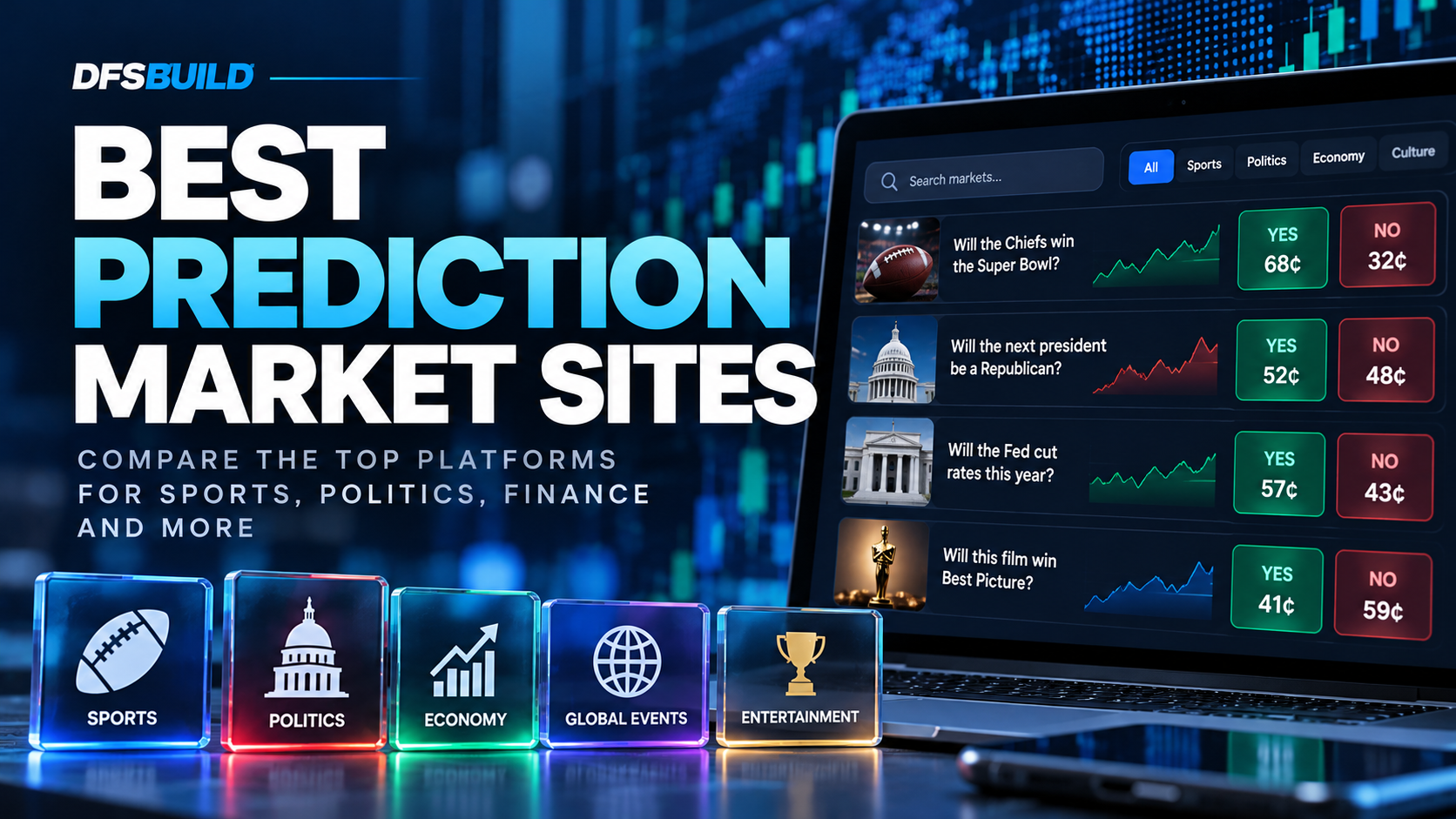
Prediction markets are transforming how people trade on real-world events, offering a new way to take positions on everything from NFL games and presidential elections to economic announcements and entertainment awards.
With more platforms entering the industry, choosing the best prediction market site is becoming increasingly important. Some platforms specialize in sports, others focus on political and financial events, and several combine multiple categories into one trading experience.
Kalshi, Polymarket, and Robinhood are among the leading prediction market platforms in 2026, but they’re far from the only options worth considering. Sports-focused alternatives such as Novig and ProphetX also give traders different ways to participate in event-based markets.
We’ve assembled 10 prediction market sites and apps worth comparing, examining their market selections, trading features, pricing structures, and overall appeal. Whether you’re new to event contracts or searching for an alternative to your current platform, here’s what to know before choosing where to trade.
Best Prediction Market Sites in 2026: Our Top 10 Picks
The best prediction market sites aren’t necessarily the ones with the biggest names. Contract availability, pricing, liquidity, and the types of events you want to trade can make one platform considerably more appealing than another.
Here are our top 10 prediction market platforms to consider in 2026:
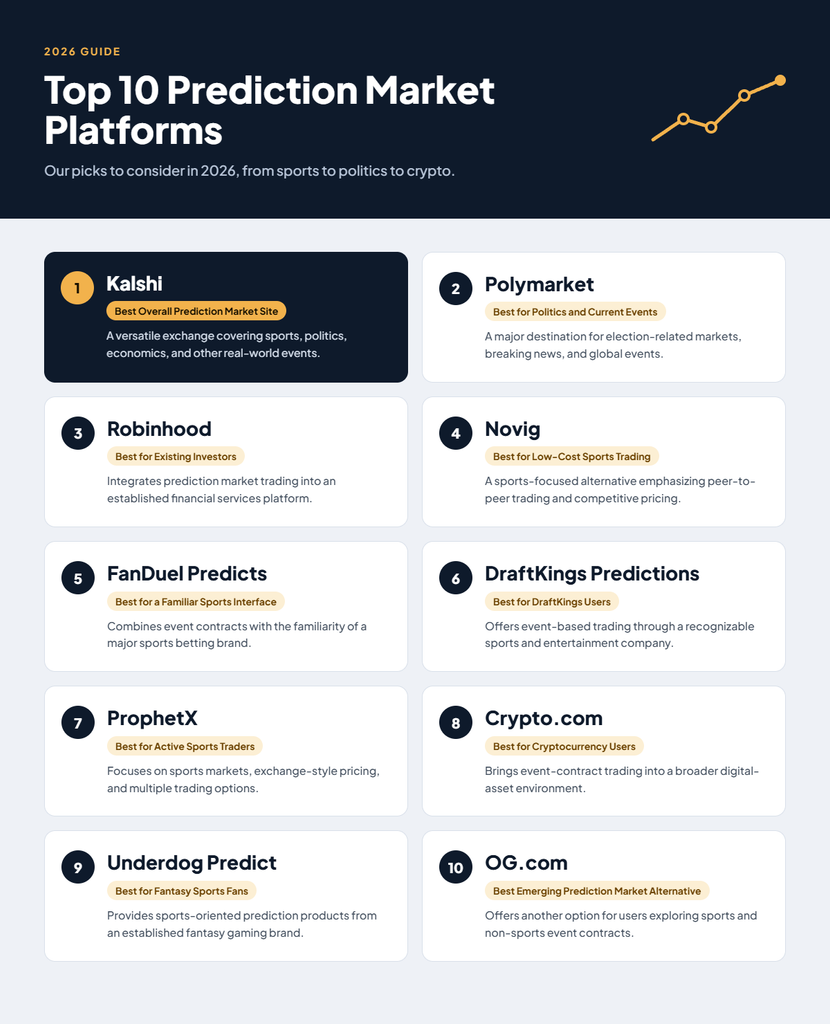
These rankings reflect each platform’s positioning and potential appeal rather than a claim that every platform has been personally tested. Eligibility and available products depend on location.
Compare the Best Prediction Market Sites and Apps
Not every prediction market platform serves the same audience. Some provide extensive coverage of political and economic developments, while others prioritize sports trading or convenience for existing customers.
The following comparison highlights where each platform fits into the market.
| Prediction Market | Best For | Primary Appeal |
|---|---|---|
| Kalshi | Overall experience | Broad event selection |
| Polymarket | Politics and news | Elections and current events |
| Robinhood | Investors | Integrated financial platform |
| Novig | Sports traders | Low-cost pregame trading |
| FanDuel Predicts | Sports fans | Familiar brand and interface |
| DraftKings Predictions | Existing DraftKings users | Sports and event contracts |
| ProphetX | Active traders | Sports-focused exchange |
| Crypto.com | Crypto enthusiasts | Digital assets and event markets |
| Underdog Predict | Fantasy sports fans | Sports-oriented experience |
| OG.com | Alternative platforms | Multiple event categories |
The most useful comparison isn’t simply which platform offers the greatest number of markets. It’s whether those markets are relevant to your interests, sufficiently liquid, and available at a reasonable total trading cost.
A platform with hundreds of unfamiliar contracts may be less useful than one offering a smaller selection of events you understand.
Best Prediction Market Platforms Reviewed
1. Kalshi — Best Overall Prediction Market Site
Kalshi stands out as one of the most versatile prediction market platforms available to U.S. traders. Its selection of event contracts spans several major categories, allowing users to explore sports, political developments, economic indicators, and cultural events without moving between multiple services.
That versatility is a major reason Kalshi earns our top overall recommendation.
Unlike platforms primarily associated with sports, Kalshi offers opportunities to trade on a broader collection of real-world outcomes. Users interested in the Federal Reserve, inflation reports, election results, or major sporting events can explore those subjects through the same marketplace.
Kalshi also operates a CFTC-regulated exchange, providing an established federal regulatory framework for its event-contract business. However, federal oversight does not eliminate legal disputes involving particular contracts or guarantee availability in every state.
Why Kalshi stands out: Its combination of event variety and dedicated trading features makes it a compelling starting point for users who want to explore multiple prediction market categories.
Potential drawbacks: Trading costs vary by contract, and understanding order books, settlement rules, and changing market prices can take practice.
Best for: Traders seeking a well-rounded prediction market experience rather than a platform dedicated exclusively to sports.
2. Polymarket — Best for Politics and Current Events
Polymarket has become one of the most recognizable names in prediction markets, particularly when major political or international developments dominate the news.
Its appeal comes from turning questions about future events into tradable markets. Instead of simply reading predictions from analysts or opinion polls, users can observe how participants collectively price the likelihood of different outcomes.
Elections are an important part of Polymarket’s identity, but the platform’s broader appeal extends to economics, technology, sports, entertainment, and international affairs.
For traders interested in news-driven markets, that range of subjects is especially attractive. Major developments can change market expectations quickly, creating opportunities to buy or sell contracts as new information emerges.
U.S. users should distinguish between Polymarket’s international operations and its U.S.-regulated offering. Product availability, trading requirements, and eligible markets are not necessarily identical.
Why Polymarket stands out: Its emphasis on politics, breaking news, and real-world developments makes it particularly interesting for users who follow current events.
Potential drawbacks: The availability of specific markets and features depends on the applicable platform and jurisdiction.
Best for: Political enthusiasts, news followers, and traders who prefer event-driven markets outside traditional sports.
3. Robinhood — Best Prediction Market App for Investors
Robinhood brings prediction market trading into an environment already familiar to many retail investors.
Rather than requiring customers to learn an entirely separate financial platform, Robinhood offers access to event contracts alongside its broader investing services.
This approach may be especially attractive to people who already use Robinhood to follow stocks, exchange-traded funds, cryptocurrencies, or other financial products.
Event contracts also provide a different way to express views about economic developments. For example, a trader following monetary policy might be interested in contracts tied to Federal Reserve decisions rather than taking a position in an individual stock.
However, event contracts have different payout structures and risks from traditional investments. They should not be treated as interchangeable products.
Robinhood’s convenience is its biggest advantage, particularly for existing customers who prefer managing multiple financial activities within a familiar application.
Why Robinhood stands out: Its integration of prediction markets into a broader investing experience creates a convenient entry point for established users.
Potential drawbacks: Dedicated prediction market exchanges may offer different trading tools, contract selections, or pricing arrangements.
Best for: Existing Robinhood customers and investors interested in adding event contracts to their trading activities.
4. Novig — Best for Low-Cost Sports Prediction Markets
Novig takes a sports-first approach to prediction markets, emphasizing an exchange model in which participants trade against one another.
Its focus on pricing is particularly interesting for people accustomed to conventional sportsbooks.
Traditional sportsbooks typically incorporate a margin into their odds. Exchange-style sports platforms use a different structure, allowing participants to interact through a market rather than relying entirely on prices established by a bookmaker.
Novig has promoted fee-free pregame straight trading, making it a notable option for traders who prioritize transaction costs. That does not mean every type of transaction is free or that users will always receive the most favorable price.
Available liquidity, spreads, live-trading fees, and contract selection still influence the overall value of a trade.
Novig is less suited to users primarily interested in elections or economic developments. Its strength is its specialization in sports.
Why Novig stands out: Its sports-focused exchange and pregame pricing model provide an alternative to both conventional sportsbooks and broader prediction market platforms.
Potential drawbacks: A narrower event selection and differences between pregame and live-trading costs.
Best for: Sports traders who pay close attention to pricing and want an alternative to conventional sportsbook odds.
5. FanDuel Predicts — Best for a Familiar Sports Experience
FanDuel Predicts represents the expansion of a major sports betting brand into the event-contract industry.
For users already familiar with FanDuel, the company’s prediction market offering may feel like a natural extension of the way they follow sports and financial events.
The appeal is straightforward: event contracts provide another way to take positions on outcomes, while the FanDuel brand offers a recognizable starting point.
However, prediction markets and conventional sportsbooks are not identical. Contract prices are influenced by trading activity, and users must consider the applicable transaction fees, market liquidity, and settlement rules.
FanDuel Predicts also illustrates why state availability deserves special attention. Access to the application does not necessarily mean every user can trade sports contracts. Different event categories may be subject to different restrictions.
Why FanDuel Predicts stands out: Its established brand and sports-oriented experience may appeal to people exploring prediction markets for the first time.
Potential drawbacks: Sports contract availability can be substantially narrower than general platform availability.
Best for: Users who prefer recognizable sports brands and want to explore event-contract trading.
6. DraftKings Predictions — Best for Existing DraftKings Users
DraftKings Predictions gives the company another way to participate in the growing market for event-based trading.
DraftKings is already familiar to many sports fans through its sportsbook and daily fantasy sports products. Its prediction market offering builds on that familiarity while introducing a different trading structure.
Rather than purchasing a conventional sportsbook wager, users trade event contracts linked to specific outcomes.
The distinction matters because the price of a contract, the available order book, and the applicable fees can influence the potential return.
DraftKings Predictions may be particularly appealing to customers who already follow the company’s other products and want to explore another type of sports-related activity.
The available contract categories may also extend beyond sports, depending on the product and jurisdiction.
Why DraftKings Predictions stands out: Its recognizable brand makes it a natural comparison point for existing DraftKings customers.
Potential drawbacks: Availability and contract selection can vary by location, and the prediction market product should be evaluated separately from the company’s sportsbook.
Best for: DraftKings users interested in event contracts and sports-related prediction markets.
7. ProphetX — Best for Active Sports Traders
ProphetX is another sports-focused prediction market alternative that deserves attention from people who regularly evaluate betting prices.
The platform emphasizes an exchange-style trading environment rather than the conventional sportsbook model.
This distinction can be particularly appealing to experienced sports traders who already understand concepts such as implied probability, market movement, and price sensitivity.
For these users, the important question isn’t necessarily which team is most likely to win. It’s whether the available contract price offers attractive value relative to their assessment of the outcome.
ProphetX’s sports specialization gives it a different identity from broader platforms such as Kalshi and Polymarket.
Its appeal depends on the availability of the sports and contract types a trader wants, as well as liquidity and the costs associated with entering or exiting positions.
Why ProphetX stands out: Its emphasis on sports trading makes it relevant for users who actively compare prices and evaluate market opportunities.
Potential drawbacks: A sports-centered platform offers less variety for users primarily interested in politics, economics, or entertainment.
Best for: Experienced sports traders who want to explore exchange-based pricing.
8. Crypto.com — Best for Cryptocurrency Users
Crypto.com brings event-contract trading into a financial ecosystem already associated with digital assets.
For cryptocurrency enthusiasts, this combination may be particularly interesting because it connects two markets that frequently attract users comfortable with volatility, price movement, and active trading.
Prediction markets differ significantly from cryptocurrencies, however. Event contracts typically resolve according to a defined outcome, while cryptocurrency prices fluctuate based on broader supply, demand, and market conditions.
That makes understanding contract settlement especially important.
Crypto.com’s event-contract offering provides an additional way for eligible customers to participate in markets tied to future outcomes, including sports and other supported categories.
Users should evaluate the costs and conditions of the event-contract product independently of the platform’s cryptocurrency services.
Why Crypto.com stands out: It provides an event-trading option within a broader digital-asset platform.
Potential drawbacks: The product structure, available contracts, and trading requirements differ from ordinary cryptocurrency transactions.
Best for: Crypto.com customers and digital-asset users interested in exploring prediction markets.
9. Underdog Predict — Best for Fantasy Sports Fans
Underdog has built its identity around sports gaming and fantasy-related products, making its prediction market offering an interesting development for sports-focused users.
For people already familiar with fantasy contests and sports projections, event contracts introduce another way to evaluate outcomes.
However, fantasy contests and prediction markets operate differently.
Fantasy players generally build entries around athlete performances or contest rules. Prediction market traders purchase contracts linked to defined events, with prices that can change as participants react to new information.
Understanding this distinction is important, particularly when comparing payouts, fees, and risk.
Underdog’s broader sports identity may appeal to users who enjoy evaluating teams and players but want to explore additional formats.
Why Underdog Predict stands out: Its connection to the fantasy sports audience provides a familiar starting point for sports-focused users.
Potential drawbacks: Product access and eligible event categories can differ by state, and fantasy gaming experience does not automatically translate into profitable trading.
Best for: Sports enthusiasts familiar with fantasy contests who want to understand event-contract trading.
10. OG.com — Best Emerging Prediction Market Alternative
OG.com rounds out our list as an alternative for users interested in exploring the expanding prediction market industry.
While the largest prediction market brands attract much of the attention, competition is bringing additional platforms and trading experiences into the sector.
OG.com offers event-contract opportunities across multiple categories, providing another option for users comparing the available market landscape.
Its appeal is not necessarily that it replaces a larger platform. Instead, it gives traders another marketplace to evaluate for contract availability, pricing, and usability.
That can be worthwhile when a particular event is unavailable elsewhere or when users want to compare how different platforms structure similar contracts.
As with any prediction market, users should verify the platform’s current trading rules, fees, supported locations, and settlement procedures.
Why OG.com stands out: It adds another multi-category alternative to an increasingly competitive prediction market industry.
Potential drawbacks: Users should carefully evaluate liquidity and contract availability rather than assuming every market will be as active as those on larger exchanges.
Best for: Traders interested in comparing additional event-contract platforms.
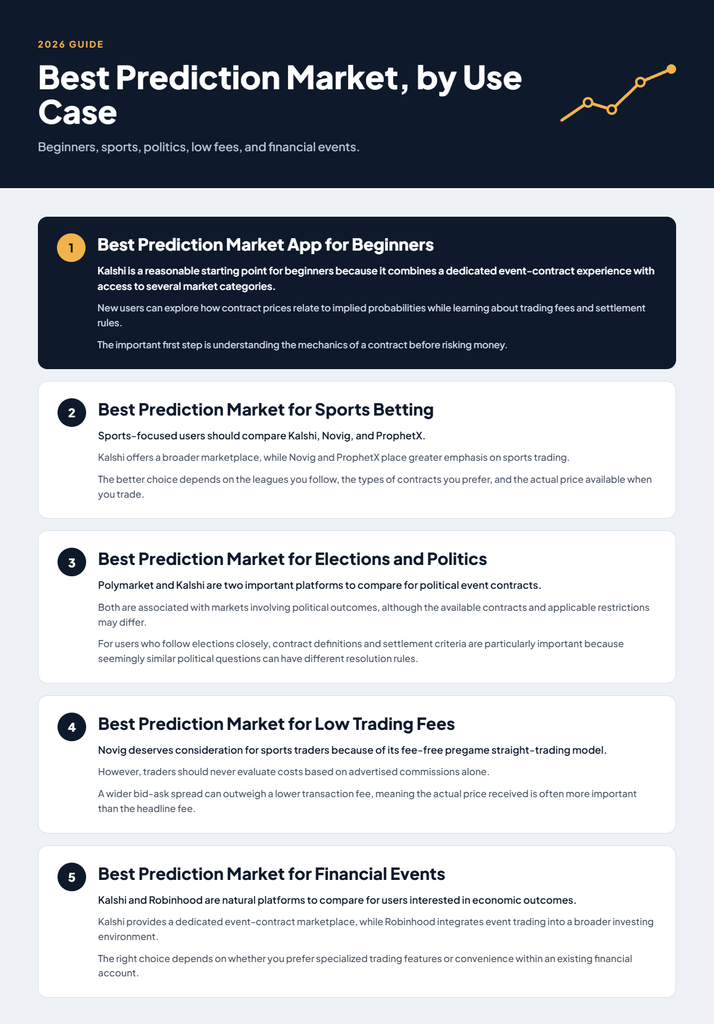
Which Prediction Market App Is Best for You?
The best prediction market app depends less on its overall popularity and more on what you want to accomplish.
A political enthusiast and an NFL trader may have completely different priorities, even if both are searching for the same general type of platform.
Best Prediction Market Sites for Sports Betting
Sports have become an important part of the prediction market industry’s expansion.
The concept is appealing to sports fans: instead of accepting a traditional sportsbook price, users can participate in markets where contracts are bought and sold based on expectations about game outcomes.
However, not all sports prediction markets work the same way.
Contract availability, live trading, order types, fees, and settlement procedures can vary significantly between platforms.
Best NFL Prediction Market Sites
NFL prediction markets are particularly relevant because football generates substantial interest in individual games, playoff scenarios, and championship outcomes.
Kalshi, Novig, and ProphetX are among the platforms worth comparing for football-related contracts.
When evaluating an NFL market, traders should consider more than which team they believe will win.
Contract prices reflect market expectations, and a strong favorite can still represent poor value if its price is too expensive.
Best NBA Prediction Market Apps
Basketball presents a different trading environment because NBA teams play frequently and new information can influence expectations throughout the season.
Injuries, lineup changes, scheduling situations, and team performance can all affect how traders evaluate outcomes.
Platforms offering NBA-related event contracts provide a way to express those views, subject to their available market rules.
For active NBA followers, liquidity and the ability to exit positions may be particularly important when new information becomes available.
Best Prediction Markets for MLB, NHL, and Soccer
Prediction markets are not limited to football and basketball.
Depending on the platform, users may find contracts involving baseball, hockey, soccer, and other sporting events.
The most important consideration is whether a particular marketplace provides the contracts you want at prices that make sense.
A platform with excellent NFL coverage may not necessarily offer equally attractive markets for every other sport.
Can Prediction Markets Replace Sportsbooks?
Prediction markets provide an alternative to traditional sportsbooks, but they are not exact substitutes.
Sportsbooks generally offer wagers at posted odds, while prediction markets use event contracts that can be traded according to the platform’s market structure.
That creates different considerations for pricing, transaction costs, and early exits.
Prediction markets also face their own regulatory questions, meaning availability can differ from conventional sports betting.
For some users, event contracts may become a preferred way to express sports opinions. Others may continue using traditional sportsbooks because they prefer familiar betting formats.
Kalshi vs. Polymarket: Which Is Better?
Kalshi and Polymarket are two of the most prominent names in the prediction market industry, making them natural competitors for users exploring event-contract trading.
Although they share similarities, their identities are somewhat different.
Kalshi emphasizes a broad regulated exchange experience with contracts spanning sports, economics, politics, and entertainment.
Polymarket has become particularly associated with elections, political developments, and the way market prices respond to breaking news.
| Category | Kalshi | Polymarket |
|---|---|---|
| Major strength | Broad event marketplace | Politics and current events |
| Sports contracts | Yes | Yes, where supported |
| Political markets | Yes | Yes |
| Economic events | Yes | Yes |
| U.S. trading | Subject to eligibility | Through applicable U.S. offering |
| Key consideration | Fees and market selection | Product and jurisdiction differences |
For someone seeking a versatile prediction market platform, Kalshi is a compelling overall option.
For users whose primary interest is politics and major news developments, Polymarket deserves equally serious consideration.
Neither platform guarantees better prices or profitable trades. The relative value of a contract depends on the market and the timing of the transaction.
Prediction Market Promo Codes and Signup Bonuses
Welcome offers can be another consideration when comparing prediction market sites.
As competition increases, some platforms use promotional incentives to attract new customers and encourage initial trading activity.
These promotions can take different forms, including trading credits, qualifying-deposit rewards, or incentives tied to completing certain transactions.
However, a larger advertised bonus does not automatically make a platform the better choice.
How Prediction Market Welcome Offers Work
Prediction market promotions may require users to create an eligible account, deposit funds, or complete a qualifying trade before receiving a reward.
Promotional credits can also have different restrictions from ordinary account balances.
For example, a trading credit may be usable toward eligible contracts without being directly withdrawable as cash.
Before participating in a promotion, review the eligibility requirements, expiration dates, and any conditions associated with withdrawing funds.
Are Prediction Market Bonuses Worth It?
A welcome offer can provide additional value, but it should not determine which platform you use.
Trading costs, contract availability, liquidity, and settlement rules are more important over time.
A platform offering an attractive initial promotion may still be less suitable if its markets don’t match your interests.
The best approach is to evaluate the underlying trading experience first and treat any available promotion as a secondary benefit.
How Do Prediction Markets Work?
Prediction markets allow participants to trade contracts connected to future events.
These contracts typically involve a defined question with possible outcomes, such as whether a team will win a game or whether a particular economic event will occur.
Contract prices fluctuate as traders buy and sell based on their expectations.
What Is a Prediction Market?
A prediction market is a marketplace where participants take positions on the outcomes of future events.
Rather than purchasing shares in a company, traders purchase contracts associated with specific questions.
The value of those contracts depends on the market’s expectations and the rules governing how the event will be resolved.
How Do Yes and No Contracts Work?
Many prediction markets use contracts that settle at either $1 or $0, depending on whether a specified outcome occurs.
Consider a hypothetical contract asking whether a team will win its next game.
If a YES contract costs $0.40, purchasing 10 contracts would cost $4 before fees.
If the event occurs and the contracts settle at $1 each, the trader receives $10, producing a $6 profit before fees.
If the outcome does not occur and the contracts settle at $0, the trader loses the $4 spent on the contracts, plus any applicable fees.
The potential return depends on the purchase price, settlement outcome, and trading costs.
How Do You Make Money on Prediction Markets?
There are generally two ways traders may realize profits from event contracts.
The first is purchasing a contract and holding it until settlement. If the outcome matches the position and the payout exceeds the purchase cost and fees, the trade produces a profit.
The second is selling a contract before settlement when the market price has increased sufficiently.
For example, a trader who purchases a contract at $0.30 and later sells it at $0.50 could realize a gain before fees.
However, prices can move in the opposite direction, and not every contract will have enough liquidity to support an easy exit.
Prediction market trading involves financial risk, including the possibility of losing the entire amount committed to a position.
Prediction Markets vs. Sportsbooks: What’s the Difference?
Prediction markets and sportsbooks can both involve opinions about future sporting events, but their underlying structures differ.
Traditional sportsbooks establish odds and accept wagers according to their betting rules.
Prediction markets allow participants to trade event contracts through a marketplace, with prices influenced by the activity of buyers and sellers.
| Feature | Prediction Markets | Sportsbooks |
|---|---|---|
| Main product | Event contracts | Sports wagers |
| Pricing | Market-based contract prices | Posted betting odds |
| Available subjects | Sports and non-sports events | Primarily sports |
| Early exit | Selling contracts, when supported | Cash-out, when offered |
| Trading costs | Fees and spreads | Typically built into odds |
| Regulatory framework | Depends on product and operator | State sports betting regulation |
One important difference is the range of events available.
Prediction markets can extend beyond sports into economic indicators, elections, entertainment awards, and other measurable outcomes.
That broader range helps explain why the industry is attracting interest from financial companies as well as sports-focused operators.
Are Prediction Market Sites Legal in the United States?
Prediction markets operate within a complex and evolving U.S. regulatory environment.
Some event-contract exchanges are federally regulated by the Commodity Futures Trading Commission, while disputes involving sports-related contracts have raised questions about the relationship between federal derivatives law and state gambling restrictions.
As a result, the availability of a prediction market platform does not necessarily establish that every type of contract can be traded in every state.
Are Prediction Markets Regulated by the CFTC?
The CFTC oversees U.S. derivatives markets, including certain event-contract products.
Some prediction market operators run federally registered exchanges, while other consumer-facing platforms provide access through registered exchanges or intermediaries.
However, not every service describing itself as a prediction market has the same regulatory status.
Users should verify the entity providing the product and the rules governing its contracts.
Which States Allow Prediction Market Trading?
State availability varies by operator and can also differ by contract category.
For example, a platform may offer financial event contracts in a jurisdiction where sports-related contracts are restricted.
Legal challenges and regulatory developments can also change which products are available.
For this reason, users should check the current eligibility requirements of their preferred platform before creating an account or depositing funds.
Are Prediction Markets Safe?
Regulatory oversight, security measures, and transparent settlement rules are important considerations when evaluating a prediction market.
However, a regulated platform does not eliminate trading risk.
Contract prices can change sharply, liquidity can disappear, and an incorrect prediction may result in the loss of the full amount invested.
Users should also consider account security, withdrawal procedures, and the possibility of disputed or delayed event resolution.
What Fees Do Prediction Market Sites Charge?
Trading costs are one of the most important differences between prediction market platforms.
A contract that appears attractively priced may become considerably less appealing once commissions, spreads, and other transaction costs are included.
Trading Fees and Commissions
Prediction market platforms use different fee structures.
Some charge transaction fees based on contract prices or quantities. Others may use flat charges, percentage-based commissions, or different rates for particular order types.
Certain sports-focused platforms advertise fee-free trading for eligible pregame transactions, while applying fees to other activities.
The relevant question is how much the entire transaction costs, not simply whether the platform advertises a low commission.
Deposit and Withdrawal Fees
Funding costs can also affect the trading experience.
Depending on the platform and payment method, deposits or withdrawals may involve processing charges, minimum amounts, or other restrictions.
Users should understand how they can access their funds before making a deposit.
Why Liquidity and Spreads Matter
Liquidity describes how easily a trader can buy or sell a contract without substantially affecting its price.
A market with many active participants may provide more opportunities to enter or exit positions at competitive prices.
The bid-ask spread is the difference between the highest available buying price and the lowest available selling price.
For example, a contract with a $0.48 bid and a $0.52 ask has a four-cent spread.
That difference can create a meaningful trading cost even when the platform’s advertised commission is relatively low.
For frequent traders, liquidity and spreads deserve as much attention as published fees.
How We Evaluate the Best Prediction Market Sites
Choosing a prediction market platform requires looking beyond advertising, brand recognition, and welcome offers.
Our comparison emphasizes five areas that can influence the overall trading experience.
Market Selection and Liquidity
We place significant importance on the variety of available contracts and the ability to trade them at competitive prices.
A large catalog is useful, but active markets and reasonable spreads are equally important.
Trading Fees and Pricing
Transaction costs can reduce returns, especially for people who trade frequently or purchase contracts with relatively small potential profits.
We consider how each platform structures its fees and whether its pricing model fits the intended audience.
Regulation and Availability
A platform’s regulatory structure, supported jurisdictions, and eligible contract categories are essential considerations.
We also distinguish between general account availability and access to particular markets.
Platform Usability
Clear contract descriptions, understandable pricing, and accessible account information help users make informed decisions.
A platform should make it reasonably easy to understand what is being traded and how an event will be settled.
Funding and Account Features
Deposit methods, withdrawal procedures, customer support, and account-management tools can influence the overall experience.
These features may be less visible than market selection, but they become important once users begin trading regularly.
Our rankings are editorial assessments based on publicly available platform information and product characteristics. They should not be interpreted as verified hands-on testing of every service or as a guarantee of future performance.
Frequently Asked Questions About Prediction Market Sites
What Is the Best Prediction Market Site in 2026?
Kalshi is our top overall selection because of its broad event-contract marketplace and dedicated trading experience. However, Polymarket, Robinhood, and sports-focused alternatives may be better choices for users with more specific interests.
Is Kalshi Better Than Polymarket?
Kalshi is a strong option for users seeking a broad selection of event contracts, while Polymarket is especially notable for political and news-related markets. The better choice depends on available contracts, fees, liquidity, and user eligibility.
What Are the Best Prediction Market Apps for Sports?
Kalshi, Novig, and ProphetX are among the leading platforms to compare for sports-related event contracts. FanDuel Predicts and DraftKings Predictions also provide sports-oriented alternatives, subject to availability.
Can You Bet Real Money on Prediction Markets?
Eligible users can trade real-money event contracts on supported platforms. Although consumers sometimes describe this activity as betting, event contracts have their own trading structures, rules, and regulatory considerations.
Are Prediction Market Sites Legal in All 50 States?
Not necessarily. Eligibility varies by platform, state, and contract category. Federal regulatory status does not automatically mean that every product is accessible nationwide.
Which Prediction Market Has the Lowest Fees?
There is no universally cheapest platform for every transaction. Novig’s fee-free pregame straight-trading model is notable, but traders should also consider spreads, liquidity, and any other applicable charges.
Do Prediction Market Apps Offer Signup Bonuses?
Some prediction market platforms offer promotional incentives for eligible new users. Offers can involve qualifying deposits, completed trades, or promotional credits, and their terms may change.
Can You Withdraw Money From Prediction Market Sites?
Supported real-money platforms generally provide withdrawal methods, although eligibility checks, processing times, payment methods, and account restrictions can affect access to funds.
Are Prediction Market Winnings Taxable?
Profits from prediction market trading may create U.S. tax obligations. The applicable treatment depends on the product, transactions, and individual circumstances. Users should maintain accurate records and consult a qualified tax professional when necessary.
What Is the Difference Between Prediction Markets and Gambling?
Prediction markets use contracts tied to future outcomes, while conventional gambling products operate under different structures and regulations. Sports event contracts have generated legal disputes over how federal derivatives law interacts with state gambling laws.
Final Verdict: What Is the Best Prediction Market Site?
The prediction market industry is becoming more competitive, giving consumers a growing selection of platforms for trading real-world events.
Kalshi is our top overall prediction market site for 2026, thanks to its broad selection of event categories and dedicated exchange experience.
Polymarket remains a compelling alternative for users interested in elections, politics, and breaking news. Robinhood offers convenience for existing investors, while Novig and ProphetX provide sports-focused alternatives with different approaches to pricing and trading.
The continued entry of recognizable companies such as FanDuel, DraftKings, and Crypto.com also reflects the industry’s expansion beyond its earlier niche audience.
Ultimately, the best prediction market platform depends on the events you follow, the contracts available to you, and the costs associated with trading.
Prediction markets offer an increasingly accessible way to express views about future outcomes, but participation still requires careful attention to contract terms, liquidity, regulation, and financial risk.
As the industry evolves, competition among platforms may lead to more market choices, improved trading experiences, and new ways for consumers to participate in event-based markets.